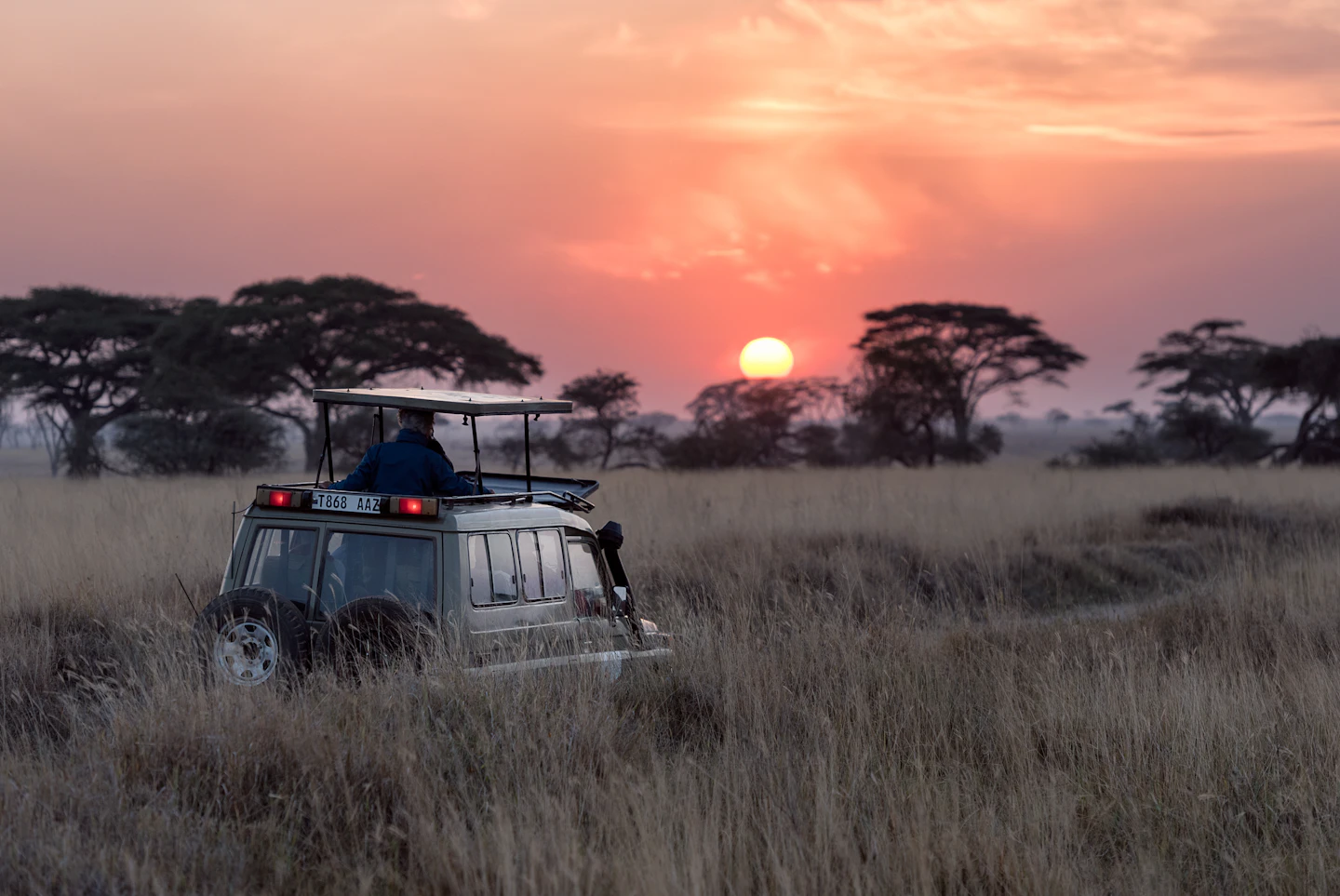
The Short Answer
The Great Migration is not one event but a year-round circuit: calving in the Southern Serengeti's Ndutu plains (December–March, peak February), Grumeti River crossings in the Western Corridor (May–August, peak June–July), and Mara River crossings into Kenya (July–October, peak August–September). Traditional aerial surveys estimate 1.3–1.5 million wildebeest; a 2025 AI satellite study counted fewer than 600,000 — the two methods disagree sharply, and neither claim should be repeated as settled fact.
The migration is a circuit, not an event
Most people picture “the migration” as a single dramatic river crossing. It is actually a continuous, roughly clockwise movement of wildebeest, zebra, and gazelle through the Serengeti-Mara ecosystem, following rainfall and fresh grazing across a 25,000 km² area spanning northern Tanzania and southern Kenya. There is no start or finish — only a location that matters more or less depending on the month you visit.
| Phase | Location | Months | What happens |
|---|---|---|---|
| Calving | Ndutu, Southern Serengeti | December–March (peak Feb) | Up to 8,000 calves born daily on short-grass plains; highest predator density in Africa |
| Western movement | Central Serengeti | April–May | Herds move northwest as the southern plains dry out |
| Grumeti crossings | Western Corridor, Serengeti | May–August (peak Jun–Jul) | Wildebeest and zebra cross the Grumeti River, with Nile crocodile ambushes |
| Mara River crossings | Northern Serengeti & Masai Mara | July–October (peak Aug–Sep) | The signature river crossings tourism markets most heavily |
| Return south | Masai Mara & Serengeti | November–December | Herds move back south toward Ndutu as short rains begin |
Calving season: the most underrated phase
From December through March, the herds concentrate on the short-grass plains around Ndutu, in the area straddling the Southern Serengeti and the Ngorongoro Conservation Area. This is calving season — hundreds of thousands of calves are born in a synchronized window, with February producing up to 8,000 births per day according to safari-industry and conservation reporting on the phenomenon.
The nutrient-rich volcanic soil of the Ndutu plains is why calving happens here specifically rather than elsewhere on the circuit — the grass at this time of year supports the sudden nutritional demand of a mass birthing event. The concentration of vulnerable newborn calves in turn draws the highest density of predators found anywhere in Africa during this window: lion, cheetah, leopard, hyena, and African wild dog all concentrate around Ndutu in February.
This phase receives a fraction of the marketing attention that river crossings get, despite arguably offering more consistent, reliable wildlife action — calving happens on a predictable annual schedule, unlike the day-to-day unpredictability of a river crossing.
Grumeti River crossings: the Western Corridor alternative
By May, the southern plains have dried out and herds move northwest into Serengeti’s Western Corridor, reaching the Grumeti River from roughly May through August, with peak crossing activity in June and July. These crossings — smaller in scale than the Mara River events but featuring the same Nile crocodile ambush dynamic — happen in a part of the Serengeti with dramatically less tourist traffic than the Mara.
The Western Corridor is largely covered by private concessions (Singita’s Grumeti Reserves being the best-known), which limits vehicle density structurally rather than through voluntary restraint. If your priority is genuine wildlife drama without the vehicle congestion that plagues peak-season Mara crossings, this phase deserves more consideration than it typically gets.
Mara River crossings: the phase everyone markets
From July, the herds move into the Northern Serengeti, and by late July or August the first groups reach the Mara River and Kenya’s Masai Mara. This is the phase every safari brochure photograph comes from: thousands of wildebeest funneling into the water at once, Nile crocodiles — a stable global population of an estimated 50,000–70,000 mature individuals — positioned in ambush, and chaotic, unpredictable crossing behavior that can take hours to begin.
Peak crossing months are August and September, though activity continues into early October in some years. The unpredictability is real and not a marketing exaggeration: herds frequently approach the riverbank, hesitate, and retreat multiple times before committing to a crossing, and there is no way to guarantee which of several crossing points will be used on a given day.
This is also where the migration’s tourism-pressure problem is most visible. Documented vehicle congestion at popular crossing points has reached 50–150 cars at a single sighting in the Masai Mara’s public reserve zones. Both the Serengeti and the Masai Mara officially cap viewing at 5 vehicles per sighting with a 10-minute limit when more vehicles are waiting — but enforcement is inconsistent, and the public reserve areas see far worse congestion than private conservancies bordering the Mara, which enforce stricter vehicle ratios independently of park authorities.
The population number nobody agrees on
For decades, the wildebeest population in the Serengeti-Mara ecosystem has been cited as approximately 1.3–1.5 million animals, based on traditional aerial survey methodology. This figure has been reaffirmed as recently as March 2023 by Tanzania’s own wildlife research institute (TAWIRI).
In September 2025, a University of Oxford study using AI-powered analysis of satellite imagery — published in PNAS Nexus — produced a radically different count: fewer than 600,000 individual wildebeest, specifically 324,202–337,926 counted in August 2022 imagery and 502,917–533,137 in August 2023 imagery.
The two methodologies have not been reconciled. We are reporting both because that is the honest state of the evidence — a single confident number here would be misleading, whichever number you pick. What both methods agree on: the wildebeest is not at conservation risk. The IUCN lists the blue wildebeest as Least Concern with a stable population trend, regardless of which count is closer to reality.
The ethics of watching a migration
The tourism-pressure evidence here is more concrete than the population count debate. Research has linked tourist vehicle presence to wildebeest hesitating, diverting, or abandoning a river crossing attempt in roughly 20% of observed cases, and elevated cortisol levels — a physiological stress marker — have been associated with proximity to human infrastructure and tourism footprint across the ecosystem.
Both Tanzania and Kenya have responded with formal rules: a 100-meter minimum distance from animals in Serengeti National Park (some sources cite 20–25 meters as an alternate figure depending on the situation), a 50 km/h speed limit in both countries’ parks, a ban on off-road driving except at designated lodge access points, and the 5-vehicle/10-minute cap at crowded sightings. The Tanzania Association of Tour Operators also launched a formal Safari Guide Code of Conduct in 2024 covering vehicle behavior specifically around migration sightings.
None of this eliminates the impact — it manages it. The single biggest lever you have as a traveler is operator choice: an operator that respects the 5-vehicle rule and doesn’t chase a crossing for a better camera angle causes measurably less disturbance than one that doesn’t.
Getting there and when to book each phase
For calving season (Ndutu, Jan–Mar): Fly into Kilimanjaro (JRO) or Arusha (ARK), then charter to an airstrip serving the Ndutu/Southern Serengeti area. This phase falls partly within the Ngorongoro Conservation Area and partly within Serengeti National Park, so confirm which permits your camp holds.
For Grumeti crossings (Western Corridor, May–Aug): Same international gateways, with charter routing to Grumeti-area airstrips — most Western Corridor camps and lodges arrange this directly.
For Mara River crossings (Jul–Oct): From Tanzania, charter to Northern Serengeti airstrips near Kogatende. From Kenya, fly Nairobi Wilson Airport (WIL) to a Masai Mara airstrip — this is a separate country entry requiring Kenya’s Electronic Travel Authorization in advance, since there is no visa on arrival. A passport valid at least 6 months with two blank pages is mandatory, and a yellow fever certificate is required if arriving from or transiting a risk country.
Malaria note: most of Kenya’s safari zones, including the Masai Mara, are moderate-risk, year-round malaria transmission areas (Nairobi’s city center and highlands above 2,500m are exceptions). Prophylaxis is recommended for all safari travel in both countries.
If your trip has room for it, pairing Mara River crossing season with a stop for Mafia Island’s whale shark aggregation (October–February) works well logistically for travelers routing through Tanzania, since the two peak windows only briefly overlap in October. Travelers extending their Tanzania safari southward, rather than routing through Kenya, should also consider Nyerere National Park’s African wild dogs — a fundamentally different ecosystem holding roughly a third of the species’ entire world population, and a genuine complement to a Serengeti-focused itinerary rather than a competing claim on the same travel window.
What this means for planning your trip
There is no version of “see the migration” that works for every month. If your priority is calving and predator density, go to Ndutu in February and accept that you will not see a river crossing. If your priority is a river crossing, go to the Mara or Northern Serengeti in August or September and accept genuine day-to-day unpredictability about when and where it happens. If you want river-crossing drama with meaningfully less vehicle congestion, the Grumeti crossings in June–July are the least-marketed, most underrated version of this trip. For the full picture on the Serengeti’s other zones, big cat populations, and park logistics beyond the migration itself, see our Serengeti safari guide.
Full month-by-month positioning, cross-referenced against lodge locations, is tracked on our migration calendar. Most safari itineraries route through Zanzibar on the way in or out — if yours does, Mnemba Atoll’s resident sea turtles are a low-effort addition that doesn’t compete with the migration’s own calendar.
Frequently Asked Questions
What is the best month to see the Great Migration?
It depends what you want to see. February is peak calving season in Ndutu, Southern Serengeti — up to 8,000 calves born daily, with the highest predator concentration in Africa. August and September are peak Mara River crossing months in both the Northern Serengeti and Masai Mara. There is no single 'best' month — there is a best month for each specific phase of the circuit.
How many wildebeest are actually in the migration?
This is genuinely unresolved. Traditional aerial surveys have estimated 1.3–1.5 million animals for decades, a figure still affirmed by Tanzania's own wildlife research institute (TAWIRI) in 2023. A 2025 Oxford University study using AI-analysed satellite imagery counted far fewer — 324,000–338,000 in August 2022 and 503,000–533,000 in August 2023. We report both because neither has been reconciled yet, and any site claiming a single precise number is oversimplifying an active scientific disagreement.
Are the Mara River crossings guaranteed if I visit in August?
No. August and September are the peak months, but crossing timing is unpredictable — herds can wait hours or days at the riverbank before committing, and a crossing you're positioned for may happen at a different point on the river the next morning. Multi-night stays (3+ nights) at a Mara River camp meaningfully improve your odds over a single-night stop.
Does tourism harm the migration?
There is documented evidence of measurable impact: research has linked tourist vehicle presence to hesitation, diversion, or abandonment of river crossings in roughly 20% of observed cases, and elevated cortisol (stress hormone) levels have been associated with human infrastructure and tourism footprint. Both the Serengeti and Masai Mara enforce vehicle limits (maximum 5 vehicles per sighting, 10-minute viewing windows when crowded) specifically because of this evidence — but enforcement varies by operator and park zone.
Serengeti or Masai Mara — which should I choose?
For calving season (Jan–Mar), it must be Southern Serengeti — the Masai Mara has no equivalent event. For river crossings, the Masai Mara's public zones see far more vehicle congestion (50–150 cars has been documented at single crossings) than Serengeti's Western Corridor Grumeti crossings in June–July, which offer comparable drama with meaningfully fewer vehicles. Private conservancies bordering the Mara (not the public reserve) close this gap significantly.
What is the wildebeest's IUCN conservation status?
The blue wildebeest (Connochaetes taurinus) is classified as Least Concern by the IUCN, with a stable population trend as of its most recent assessment. This is not an endangered-species story — the conservation question here is about tourism management and river-crossing disturbance, not population survival.
Do I need a visa to see the migration in both countries?
Tanzania and Kenya require separate visas — Tanzania's e-visa and Kenya's Electronic Travel Authorization (eTA), both obtained in advance; Kenya has no visa on arrival. A passport valid at least 6 months with 2+ blank pages is required for Kenya. Both countries require a yellow fever certificate if you are arriving from or transiting through a country with yellow fever risk.